



This article discusses practical strategies for VIC better strata committees, focusing on improving decision-making, communication, and engagement within Victorian owners corporations.
Victorian committees do a lot of heavy lifting for their communities, often as volunteers, and often under pressure. After our popular webinar with Alex McCormick from SOCM about building better strata committees and making good decisions together, we received far more questions than we could answer live.
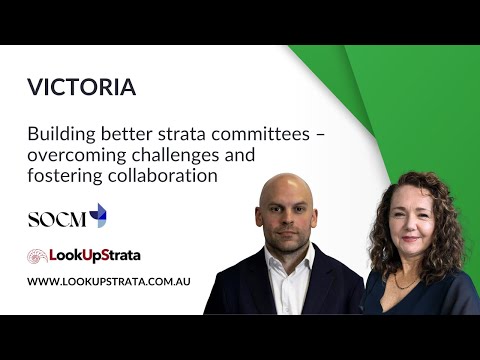
So Alex and I sat down for a separate recorded Q&A to work through some of the most common committee challenges we see in Victorian owners corporations. This article gives you a taste of the topics we covered, with a focus on practical, real-world strategies. If these questions sound familiar, watch the whole session.
Video recording coming soon.
Getting committee decisions right
A big theme in the Q&A was how committees make decisions between meetings. Many Victorian committees now make most of their decisions by email. That can be efficient, but it must also comply with the requirements for a formal ballot.
Alex stepped through the key elements of a compliant committee ballot in Victoria, including:
- Clear written notice to every committee member
- An email that states this is a resolution to be voted on, not just a casual discussion
- A properly worded motion
- A closing date for the ballot – usually 14 days, unless the matter is genuinely urgent
- Proper records of the votes kept with the owners corporation records
If your committee is sending informal emails that say things like “what do we think about this”, without a clear motion or closing date, that is not a ballot. Alex also highlighted the importance of managers requesting copies of the actual email responses, not just a summary from the chair, so that the owners corporation’s records show how each decision was made.
Managing personalities, conflict and “big voices” on the committee
Another cluster of questions focused on behaviour in meetings. Many committees have one or two dominant personalities, or people who avoid difficult conversations altogether.
Alex suggested some practical ways to keep meetings productive and respectful, including:
- Asking your manager to attend and chair key meetings so there is a neutral, professional presence
- Using a structured format where everyone has a chance to speak once on a topic, then the committee votes
- Making it clear before the meeting that you will not “re-litigate” decisions that have been made
He stressed that committees do not need unanimous decisions. Committees work as a democracy, so majority decisions are the norm, and members need to accept that they will sometimes be in the minority.
We also discussed what happens when relationships become strained after a contentious vote. Alex’s advice was to set expectations before those big decisions. Remind people that you all still live in the same building and need to work together afterwards, and that majority votes are part of life in a shared community.
Bringing new people onto the committee and onboarding them well
Several questions came from committees trying to integrate new members who want to be involved but are unfamiliar with the rules, voting processes and financial responsibilities.
Alex confirmed that committees can absolutely create internal onboarding processes without a formal rule change. Helpful options include:
- A short call with the manager or chair to explain how the committee operates
- A “welcome to the committee” document that covers roles, decision making, meeting frequency and budget basics
- A quick overview at the AGM of what the committee can and cannot decide, so new members understand the framework from day one
We also talked about new owners who are enthusiastic but sceptical of past decisions. Rather than re-running old debates, Alex encouraged committees to share minutes, financial context and the circumstances at the time decisions were made. That helps new people understand why choices were made, even if they might do things differently now.
When some committee members do not engage at all
A very common frustration is the committee member who never attends meetings, rarely responds to emails and will not resign.
Alex outlined the technical position in Victoria, where a committee member who misses a certain proportion of meetings over six months without a reasonable explanation can be removed from the committee by resolution. This sits in the regulations and effectively creates a casual vacancy that the committee can fill.
However, he also acknowledged that many committees prefer a more practical approach. If you still have a functioning quorum and the same person repeatedly fails to engage, you can treat them as an ongoing abstention and keep moving. At the next general meeting, you can explain your concerns if they stand for reelection.
The key message was not to let one disengaged member paralyse the whole committee.
Who should answer owners, and how fast?
Committees also asked about owner expectations. Some buildings now have owners who expect instant replies to emails or texts about every issue, urgent or not.
Alex’s strong view was that the manager should be the first point of contact for owners corporation queries wherever possible. That keeps records in one place and avoids situations where committee members give off-the-cuff answers from their personal inboxes that are later treated as “decisions”.
To protect volunteers from burnout and unrealistic expectations, he suggested:
- Redirecting non-urgent queries to the manager for inclusion on the next committee agenda
- Making it clear that the committee will consider non-urgent matters at the committee’s usual meeting frequency
- Avoiding long email chains that set a pattern of instant responses from individual committee members
For self-managed schemes, Alex recommended simple, polite boundary setting. It is reasonable to tell owners that you will look into the matter over the weekend or after the next informal catch-up with other committee members, rather than responding in real time.
Keeping committees focused on the right decisions
We also answered questions from committees that felt bogged down by minor choices, such as which gardener to use or whether to repaint a single wall. They wanted to know how to distinguish between decisions the committee should vote on and what can be delegated.
Alex was cautious about managers accepting open-ended delegations to make major property decisions, such as repainting or re-carpeting. In his view, that can start to look more like an administrator than a manager. Instead, he encouraged committees to:
- Use working groups or subcommittees to gather quotes and prepare recommendations
- Send clear agendas with motions ready to vote on, not just “discussion items”
- Allocate approximate times to each agenda item so meetings stay on track
The point of a committee meeting is to make decisions. A little extra planning around the agenda usually leads to more decisions and less time spent in circular conversations.
Cost, value and the maintenance fund
Money is never far from any strata discussion, and this Q&A was no exception.
Committees asked how to move conversations from “how much does it cost” to “what are we trying to achieve”. Alex suggested reminding people of their core obligation to maintain the common property and protect the value of everyone’s homes. When you frame spending in terms of obligations, asset value and insurance impacts, it can help shift attention from the immediate cost to the long term outcome.
We also touched on what belongs in the admin fund versus the maintenance fund. Alex did not nominate a fixed dollar threshold. Instead, he suggested that:
- Regular, annually recurring expenses belong in the admin budget, even if you do not know the exact figure
- The maintenance fund should align with your approved maintenance plan and cover planned capital works
Even where a maintenance plan is not strictly mandatory for a smaller scheme, Alex encouraged committees to explore one. A plan and matching fund create structure and reduce the shock of large one off levies later.
Templates, policies and where to find help
Finally, committees wanted to know if there are templates, policies or even resources outside strata that could help them set ground rules and shared goals.
Alex’s view was that strata is a specialist environment, so committees are usually better served by strata specific materials than by general corporate governance resources. Your owners corporation manager is often the best first stop. Many managers already have template policies for:
- Handling renovation requests
- Managing noise or behaviour complaints
- Using shared facilities such as balconies or common areas
He also suggested contacting SCA Victoria and relevant owner advocacy groups for further support and resources tailored to Victorian owners corporations.
On top of that, committees can intentionally decide how they want to work together. For example, you might choose to meet formally every second month for decisions, and informally over coffee in between to build rapport and talk about longer term goals. That kind of social connection often makes it easier to collaborate when difficult decisions come up.
This Q&A session with Alex covers all of these topics in more depth and works through real examples that committee members will recognise from their own buildings. If you are on a Victorian committee, or you support committees as a strata manager, we encourage you to watch the full conversation and share it with your fellow committee members.
Alex McCormick SOCM alex@socm.com.au P: 03 9495 0005
This post appears in Strata News #773.
Have a question or something to add to the article? Leave a comment below.
Read next:- VIC: Building Better Strata Committees
- VIC: Q&A Our OC engages preferred contractors without quotes or proper certification
- VIC: Q&A Managing maintenance when owners deny the existence of the owners corporation
Visit our Strata Committee Concerns, Strata By-Laws and Legislation, Strata Managers OR Strata Title Information Victoria.
Looking for strata information concerning your state? For state-specific strata information, take a look here.
After a free PDF of this article? Log into your existing LookUpStrata Account to download the printable file. Not a member? Simple – join for free on our Registration page.