
This article is about modern water ingress testing methods and their role in ensuring building weatherproofing and structural integrity.

Have you ever had a Water Ingress defect fixed and then had to wait for the next storm or wet day to find out if it was actually fixed? The only way to be certain is to test the repaired defect.
Development of Water Testing Methods
In the mid-20th century, as building technologies advanced, engineers and architects began to formalise ways to test the water resistance of building systems. By the 1970’s and 1980’s, more advanced techniques, including spray racks (simulating rain), pressure chambers, and other field tests, were developed.
In-situ tests became more common as a method of assessing the actual performance of installed building materials under controlled conditions, rather than just relying on laboratory tests.
The American Architectural Association (AAA) set forth standardized guidelines for conducting these tests, which became widely adopted by architects, engineers, and building inspectors.
The Test 501 became a key tool for verifying that the materials used in construction. For example, waterproofing seals, flashing, and membranes meet performance criteria for waterproofing and water resistance.
The test is conducted on various building components like windows, doors, and walls. Water is introduced at a specified volume and pressure rates to simulate extreme weather. Inspectors monitor for signs of leakage or infiltration inside the building.
This type of testing is particularly valuable in identifying weaknesses in the design, materials, or construction of a building envelope that could lead to water intrusion.
The American Architectural Manufacturers Association developed the 501 tests as the standard to meet for the United States construction Industry. In Australia, the in-situ test has been adopted by Architects, Facade Engineers, and Major construction companies since the NCC introduced the FP1.4 code of practice in 2019. as the requirement to address the weatherproofing of roofs and external walls, including openings around doors and windows.
Water ingress testing is a crucial step in construction that ensures the structural integrity, durability, and weatherproofing of buildings. One small leak can compromise both the safety and longevity of a building. Using the AAMA 501.2 water penetration test, verifies the resistance of a new and older building’s façade against water ingress.
Introduction to AAMA 501.2: Water Pressure Testing and Field Testing
The AAMA 501.2 standard is an industry-recognized water pressure test primarily used for quality management and compliance checks. By simulating extreme weather conditions, it tests a building’s defence against water penetration, focusing on façades and glazed curtain walls. This proactive approach not only ensures compliance under the NCC (National Construction Code) for weatherproofing but also minimizes potential liabilities.
The Australian National Construction Code F3 states, roofs, and external walls—including windows and doors—must prevent water from causing dangerous conditions, occupant discomfort, or structural damage. For glazed and curtain wall systems, AS2047 and AS4284 are the minimum compliance standards, respectively. However, when systems deviate slightly from tested designs, additional validation may be required through AAMA 501.2 testing.
Test Methodology: A Detailed Approach to Water Resistance
1. Identification of Test Location
Test locations are precisely marked on the elevation plans. This allows testers to assess each relevant point, ensuring complete coverage of the façade’s vulnerable joints.
2. Site Requirements
The water ingress test requires a collaborative effort from various members of the building management team, and the contractors and site test team. Key elements of the testing procedure involve:
- Ensuring adequate water pressure (250 kPa) with a 19 mm hose.
- Setting up visual markers for quick identification of areas under test.
- Preparing the area for testing by exposing all internal ceilings and partition works for clear visibility.
- Labelling tested areas to document each component and track modifications during the remediation process and possible retesting after remediation.
3. Test Apparatus
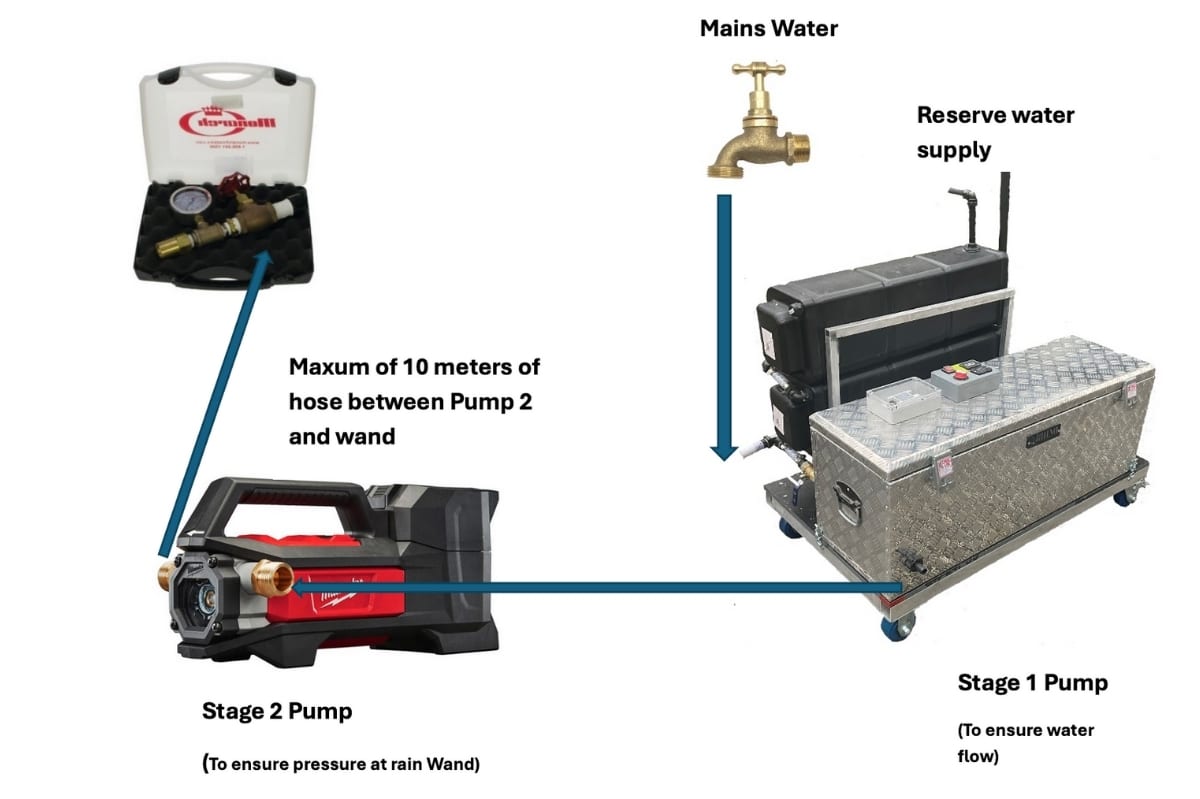
The main equipment includes a spray wand with a Type B25 nozzle, connected to a water hose, and a high-powered transfer pump. This setup simulates the impact of heavy rain by spraying water at 35 psi, covering all fixed façades and operable sections. Water pressure must be maintained at 35psi for a minimum of 15 minutes at a volume of 22.7 litres per minute. The nozzle is required to be no more than 305mm from the test surface and travel at 300mm per minute.
A sample of Test Apparatus Setup
Spray wand Nozzle Type B25 #6.030 ,19 mm hose (10m,20m, 25m). CBFS’s water storage and Pump equipment. Milwaukee transfer Pump.
4. Test Method
Starting from the lowest level of the wall section, the wand sprays water over each 1.5-meter section for five minutes, moving gradually up the façade until the designated area is completed. Observers stationed indoors monitor for any leakage using additional lighting and specialised equipment if needed.
5. Classification of Water Ingress Defects
Water leakage is classified as any uncontrolled water that reaches normally exposed interior surfaces. If this water is neither contained nor drained to the exterior, it can cause damage to nearby materials and finishes. According to AAMA 501.2-03, small collections of water (up to 15 ml) on interior surfaces are not considered leakage.
6. Test Results and Leak Identification
During the test, results are documented in real-time, and any leaks identified are classified based on location and severity. Observers meticulously note points of water ingress for further investigation.
Summary
Elevating Standards in Building Weatherproofing
In modern construction, water ingress testing is more than a quality check—it’s an assurance of safety, longevity, and resilience against the elements. Rigorous adherence to AAMA 501.2 standards demonstrates the commitment to delivering waterproof, durable structures, enhancing both function and value. With each test, performed we are ensuring that every joint and panel tested meets the industry’s highest standards for watertight integrity.
Brenton Smith
Commercial Building Facade Solutions
E: mike@cbfs.com.au
P: 02 9281 6440
This post appears in Strata News #773.
Have a question or something to add to the article? Leave a comment below.
Read next:
- QLD: Q&A Clarity on responsibility for repeated internal leaks in a high-rise
- NSW: Q&A Who pays for repairs to a leaking internal pipe in a townhouse?
- NSW: Common Property Water Leaks: A Strict Duty to Repair
This article has been republished with permission from the author and first appeared on the Commercial Building Facade Solutions website.
Visit our Maintenance and Common Property OR state-specific strata information, take a look here.
After a free PDF of this article? Log into your existing LookUpStrata Account to download the printable file. Not a member? Simple – join for free on our Registration page.
Leave a Reply